Behind Every Painting, a Small Army: Tracking One Canvas from Chicago Studio to a Living Room in Columbus
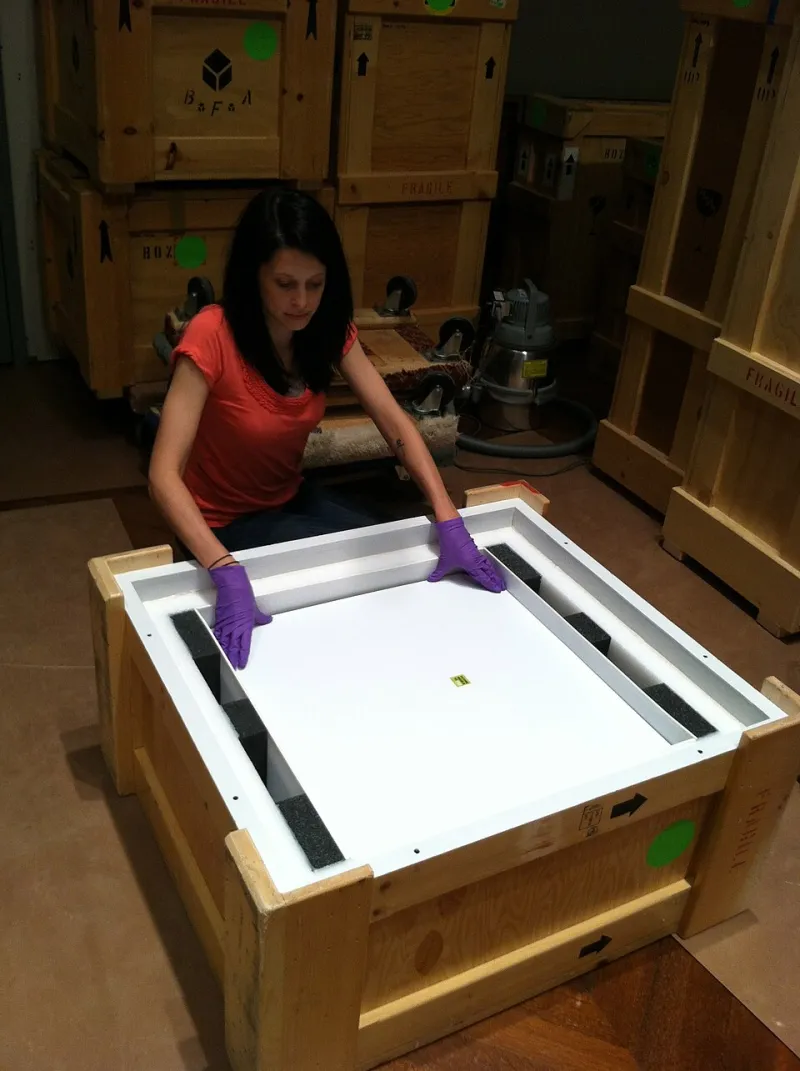
Photo: Areppertgerber, CC BY-SA 3.0, via Wikimedia Commons
The painting left the studio on a Tuesday.
It was a smallish abstract in oil and cold wax, maybe 40 by 30 inches, by a Chicago artist named Maya Renner—still early in her career, the kind of painter whose shows sell by word of mouth rather than press release. The buyer was a schoolteacher in Columbus, Ohio, named Dana Whitfield. First-time collector. Nervous. Excited. She'd seen the work on Instagram, had a video call with the gallery, and put down a deposit without ever standing in front of the thing.
What happened next took eleven days, six professionals, and roughly $1,400. Dana never saw any of it. Almost no collector does.
The Studio: Where the Journey Actually Starts
Ask anyone in the art world about logistics and they'll tell you the same thing: the most important person in the chain is the artist's studio manager—or, in the case of most emerging artists, the artist herself, wearing that hat at midnight.
Renner spent two hours prepping the painting for a journey of barely 300 miles. She wrapped the surface in glassine, cushioned the corners with foam, slid the canvas into a cardboard sleeve, and then—critically—wrote her phone number on the crate in marker.
"If something goes wrong, I want to be findable," she told us. "The painting matters more to me than to anyone else in the chain. It's not a product. It's six months of my life."
Then she called the first of the six professionals: a fine art shipper. Not FedEx. Not UPS. A specialist.
Why You Can't Just Mail a Painting
Here's something most first-time buyers learn the hard way: a painting is not a package. Standard carriers handle art, technically. But a canvas is a weird, fragile, temperature-sensitive object with a frame that can crack if the humidity swings fifty points in a truck crossing Indiana in January.
Fine art shippers exist because of this. Companies that specialize in art transport—which range from local outfits to national names like Artex or Crozier—build custom crates, climate-monitor their vehicles, and carry insurance policies written specifically for objects with no fixed market value. A small piece like Renner's might travel in a soft wrap inside a shared, climate-controlled van. Something bigger or pricier gets a plywood crate built to order, at $300 to $800 a pop.
Renner's painting went into a shared van run by a regional shipper out of Bridgeport on the South Side. The driver, a man named Curtis who's been hauling art for nineteen years, has opinions about this part of the job.
"People think we're furniture movers," he says. "We're not. I know what every crate on my truck is worth, and I know which corner of the truck it needs to ride in. That's the job."
The Middlemen You Never Meet
Between the studio and Dana's living room, the painting passed through hands that never appear on an invoice line item with a friendly name:
- The registrar, the gallery's logistics brain, who booked the transit, confirmed insurance coverage, and photographed the painting's condition before it left—so that if anything went wrong, there'd be a paper trail.
- The insurance underwriter, who assessed the risk of the route and priced the coverage. For emerging artists, whose market values are still forming, this is genuinely tricky. What is a $4,000 painting worth if it's destroyed? The answer, usually, is "what the gallery says it is," which is why documentation matters.
- The receiving handler, a Columbus-based art services company that accepted the delivery, inspected the piece, and held it for two days until Dana's installation appointment.
Each of these steps cost money. Dana's $1,400 in "shipping and handling" breaks down roughly like this: $350 for transit, $500 for crating and prep, $200 for insurance, $250 for receiving and storage, and a $100 administrative fee that made her wince until she understood what it covered.
"I thought shipping would be two hundred bucks," she admits. "Then I thought about it like, this thing is irreplaceable. What's the right number to protect something irreplaceable? Probably more than that, honestly."
The Last Fifty Feet
The final stage is the one collectors most often try to skip: installation.
Dana had a hammer. Dana had a wall. Dana very briefly considered doing this herself—until the installer, a former museum preparator named Joel, showed her a photo of a 60-pound canvas that had ripped out of a drywall anchor in a client's hallway and landed face-down on a radiator.
Joel arrived with a laser level, a stud finder, wall anchors rated for twice the painting's weight, and forty minutes of quiet expertise. He hung the painting, adjusted it a quarter inch twice, stepped back, and asked Dana how it made her feel.
"I cried a little," she says. "Which is embarrassing. But it was the first time I'd seen it in person. And this stranger just... made it real."
What the Crates Know
There's a saying among art handlers: the crate tells the story. Open a well-made one and you can read the whole journey—where the corners were stressed, who padded what, whether someone cared.
The art world loves to write about prices, trends, and which hot young painter just had a sell-out show. It almost never writes about Curtis the driver, or Joel and his laser level, or the registrar photographing a canvas at 7 a.m. so a schoolteacher in Ohio can hang it safely that evening.
But every collector—whether they're buying their first $2,000 piece or their tenth $2 million one—is tacitly relying on this chain. The market for fine art logistics in the US is estimated in the billions, and it's growing as collecting spreads beyond the coasts. More Dana Whitfields mean more paintings on more trucks.
Renner's painting now hangs in Columbus, above a reading chair, catching afternoon light. Dana sends the gallery a photo every few months. The crate sits in her garage—"just in case," she says.
Just in case of what, she doesn't know. But somewhere, Curtis and Joel would both approve.