Forty Dollars a Tube: The Quiet Economics Deciding What Ends Up on the Wall
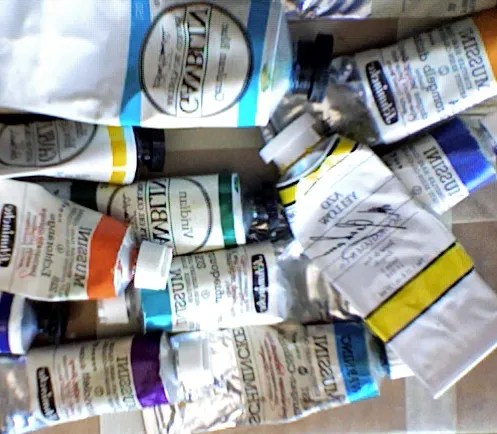
Photo: User:Bus stop, CC BY-SA 3.0, via Wikimedia Commons
Ask an artist why a painting looks the way it does, and they'll usually talk about composition, mood, or a reference they can't stop thinking about. Ask them what it cost to make, and the conversation changes. Suddenly you're hearing about cadmium prices, lead times from a mill in Ohio, and the painful math of a 40-inch canvas that ate a week's income before a single brushstroke landed.
The art world loves to talk about the market for finished work. Almost nobody talks about the market for the stuff work is made of. But spend a few hours with the people who grind pigment for a living, and you start to see paintings differently — as the end product of a supply chain most collectors never think about.
The Most Expensive Colors in the Room
Walk into any serious paintmaker's studio and you'll find a wall of raw materials that reads like a stock ticker. Genuine cadmium red, prized for its saturated warmth and lightfastness, has climbed sharply in recent years as mining regulations and demand from industrial applications tighten supply. Cobalt blue, that luminous staple of every painting student's fantasy palette, depends on metal markets that swing with global manufacturing.
Meanwhile, the workhorse colors — titanium white, mars black, the yellows made from synthetic inorganic pigments — stay cheap and reliable. Which helps explain a pattern that's hiding in plain sight at gallery after gallery: the paintings that dominate walls tend to lean on affordable, stable colors, while the expensive stuff gets rationed, mixed, or saved for the one moment a composition truly demands it.
"Artists aren't just choosing colors," one Brooklyn-based paintmaker told us. "They're choosing prices. A young painter on a budget will stretch a little cadmium a long way. You can see it in the brushwork — those colors get used like they cost something, because they do."
What a $40 Tube Actually Buys
To a newcomer, forty dollars for paint sounds absurd. To anyone who's stood at the counter of an art supply shop holding a Series 4 tube, it's just Tuesday.
But break it down and the economics get interesting. A single large canvas might take several tubes of paint, plus primer, plus stretcher bars, plus varnish. Add studio rent — the invisible line item that dwarfs everything else in cities like New York, Los Angeles, and Chicago — and a painting can carry several hundred dollars in materials alone before the artist has paid themselves a cent.
This is why the pricing conversations we've covered before — the awkward, honest math of emerging art — have a hidden floor. Dealers sometimes talk about it openly: certain sizes and certain kinds of work simply can't be sold cheaply, because the materials themselves won't allow it. A massive, heavily-pigmented abstract in genuine ultramarine and cadmium can't survive at a $300 price point. A small ink drawing can. The materials are quietly sorting the market before any gallery gets involved.
Why Certain Colors Own the Museum
Here's where it gets fun for anyone who likes conspiracy theories that turn out to be mostly true. The reason so many celebrated paintings lean on a familiar palette isn't just taste. It's history, chemistry, and money braided together.
Some of art history's most legendary colors were ruinously expensive — the ultramarines ground from lapis lazuli that were once worth more than gold — and their scarcity shaped entire eras of painting. Today's equivalents are less romantic but just as real: pigments discontinued for toxicity, series bumped up a price tier overnight, or a supplier's minimum order forcing a painter to commit to one blue for a whole year.
Museums, with their conservation departments and lightfastness requirements, effectively act as the final arbiters of which pigments are considered serious. Colors that fade, shift, or degrade get weeded out of the professional conversation. What survives is a relatively small, battle-tested palette — and that palette is what you're looking at, whether you're in the Met or a project space in Marfa.
The Underrated Investment
So is a tube of paint an investment? Strictly speaking, no. But the logic of spending well on materials is one of the art world's quietest wisdoms.
Artists who buy quality materials produce work that lasts — and work that lasts is work that can be collected, resold, and written about decades later. Conservators will tell you that a surprising share of the problems they see come from cheap supports and unstable pigments used by artists who couldn't afford anything better. The tragedy isn't aesthetic. It's archival.
For collectors, this suggests a question worth asking that almost nobody asks: what is this made of? Not in a precious, condition-report sense, but as a window into the artist's practice. An emerging painter investing in professional-grade materials is making a statement about longevity. One cutting corners on supplies may be resourceful — or may be producing work that won't look like this in twenty years.
Reading a Wall Differently
The next time you're at an art fair or a gallery opening, try a small experiment. Look past the subject matter and ask what the palette is telling you. Those deep, saturated reds and blues carry real material cost. The dusty earth tones and confident whites are often the budget-savvy choices of an artist who knows exactly where their money goes.
None of this diminishes the work. If anything, it deepens it. Every painting is a record of a hundred small economic decisions — which pigment, which canvas, how much of the good stuff to spend on this one piece. The market sees the finished object. But the object remembers what it cost.
And that $40 tube? It might just be the most honest price in the entire art world.