Meatloaf and Minimalism: Inside the Garage Gallery Opening Down the Street
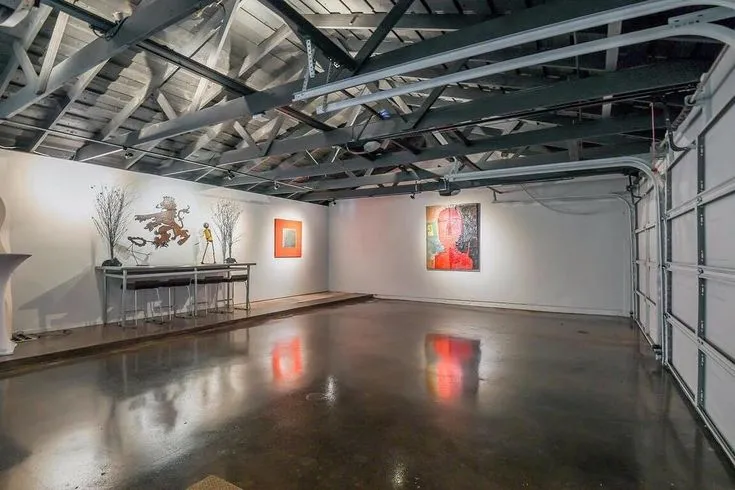
Photo: suburban garage converted art gallery opening night, via i.pinimg.com
The gallery has no sign, no press release, and no climate control. What it does have is a folding table of cheese cubes, a heat lamp borrowed from a church basement, and forty-one paintings leaning against a garage door that still smells faintly of lawnmower oil.
Welcome to the opening. Try the punch.
The Hostess With the Mostest (Wall Space)
Diane Kowalski—no relation to the Warhol muse, she's quick to joke—spent thirty-two years teaching fourth grade in Reynoldsburg, Ohio. When she retired, she did what a lot of people do: cleaned out the garage. Unlike most people, she then hung drywall, painted it gallery-white, installed track lighting from a big-box hardware store, and invited every artist under fifty she could find on Instagram to show with her.
"I figured if I could get eight-year-olds excited about anything, I could get adults excited about a painting," she says, adjusting a frame that is, to be honest, hanging slightly crooked. Nobody mentions it. Nobody cares.
Her first show, last spring, drew eleven people—mostly neighbors who came for the cookies and left with two purchases. This one, her fourth, drew a couple who drove three hours from Indianapolis after seeing a post in a collector Facebook group. They came for the art. They stayed for the meatloaf. They left with a small abstract by a twenty-six-year-old community-college dropout named Marcus, who was standing in the driveway in a fleece vest, visibly stunned that anyone wanted his work.
Why Collectors Are Pulling Into the Driveway
Here's the thing nobody in the institutional art world likes to say out loud: formal galleries can feel like airports. You're being watched, priced, and funneled. The suburban home show is the opposite. There's no gallerist sizing up your shoes. There's a dog named Biscuit asleep on a rug you could theoretically buy the painting off of, because it's hanging over the actual sofa.
And that's precisely the appeal for a growing slice of American buyers. Seeing work in a living room answers a question no white cube can: what does this look like in a real house? The track lighting is imperfect. The walls are drywall. If a painting survives Diane's garage with its dignity intact, it can survive anything.
There's also trust. Home gallerists like Diane don't have inventory pressure or stable-of-artist politics. They show what they love, they sell at honest prices—most pieces here top out around $900—and they take maybe fifteen percent instead of fifty. "I'm not trying to make a living," Diane shrugs. "I already made a living. I'm trying to make Saturdays."
The Unlikely Gatekeepers
What's quietly emerged is a new class of tastemaker: the retired, the semi-retired, the empty-nester with a good eye and a basement. They have no MFA, no dealer relationships, no Chinatown loft. What they have is time, taste, and square footage—the three resources the traditional art world runs on.
Artists have noticed. Marcus, the driveway sensation, submitted to twelve brick-and-mortar galleries before Diane. He heard back from none. Diane responded to his DM in four hours. "She asked me what the paintings were about," he says. "That was it. That was the whole interview."
The shows themselves run on a hybrid etiquette. Bring a dish if you want. Look closely. Ask questions. If you love something, take a photo of the little price sticker and Venmo. Receipts are handwritten on index cards. One collector asked about a certificate of authenticity; Diane handed him a certificate of authenticity she'd made on Canva, signed with a flourish. It was perfect. It was, frankly, more charming than any embossed document.
Is This the Future, or Just a Nice Saturday?
Skeptics will point out the obvious: no insurance, no conservation standards, no artist protection contracts. All true. But the traditional model isn't exactly winning hearts either, especially outside the coasts, where gallery density thins out fast and the nearest blue-chip space might be a four-hour drive.
The garage gallery doesn't replace the institution. It just refuses to wait for it. Between the coasts, in the cul-de-sacs and church basements of middle America, art is getting shown, seen, and sold by people who never asked permission.
By the end of the night, three pieces have found homes, including one that's staying right where it is—the buyer is Diane's next-door neighbor, and she bought it, she says, "because it looks amazing over my own couch, which I now know because I saw it over hers."
Diane is already planning the next show. The theme, she says, is "things that glow." She's thinking string lights. The artists are thinking bigger. Everybody's invited. There will be meatloaf.